
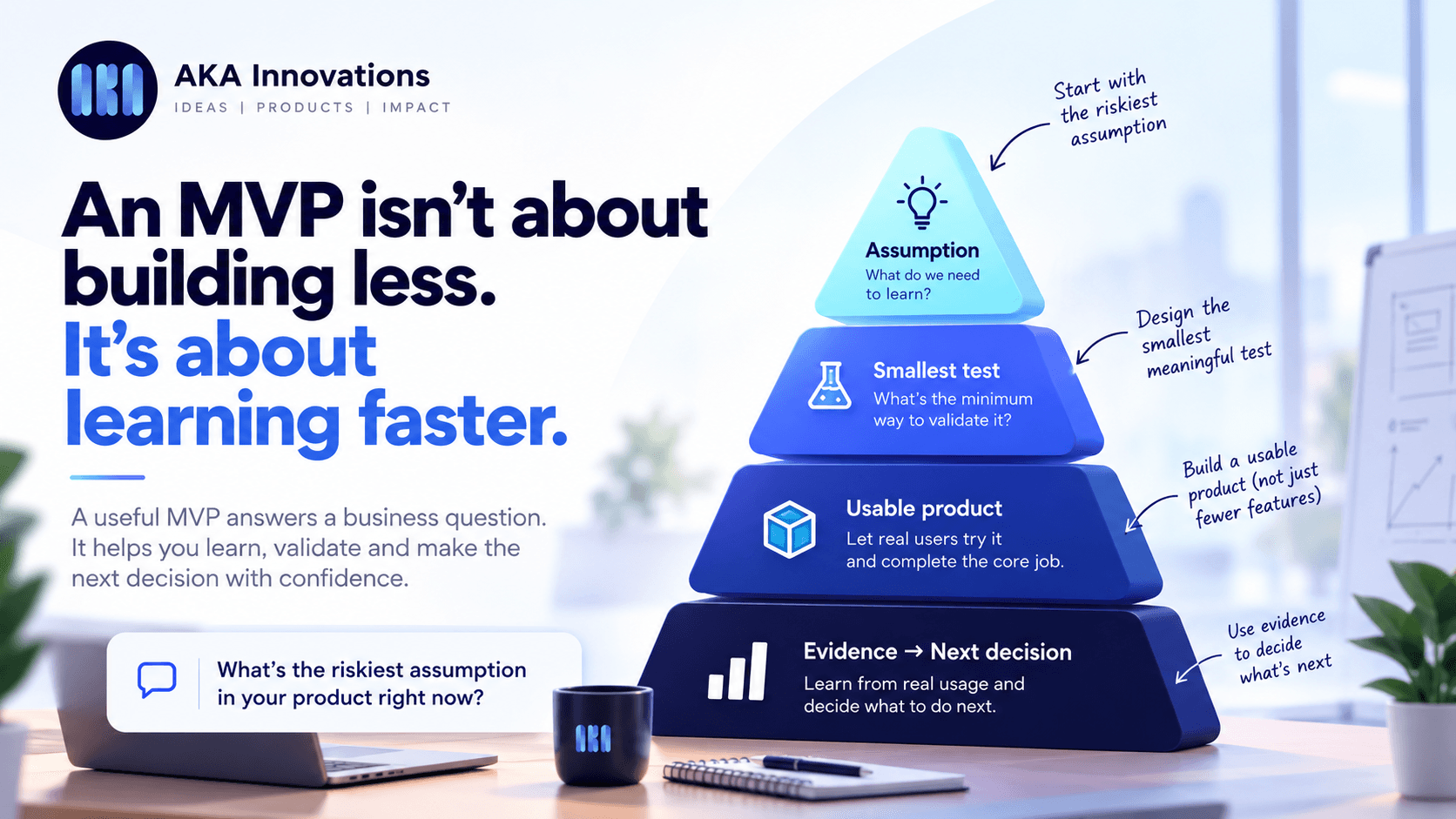

An MVP isn’t about building less.
It’s about learning faster.
One of the easiest mistakes in product development is confusing a smaller product with a better MVP.
You remove features.
You simplify the screens.
You cut the scope.
And then call it an MVP.
But if you haven’t defined what you’re trying to learn, you’ve only built a smaller version of the same uncertainty.
A useful MVP should answer a real business question:
→ Can users actually complete the core job?
→ Do they understand the workflow without being hand-held?
→ Will they come back and use it again?
→ Does the workflow make sense operationally?
→ Is the problem painful enough for someone to care?
The starting point shouldn't be:
“What features can we remove?”
It should be:
“What assumption could make this product fail?”
Then build the smallest usable thing that can test that assumption.
Assumption → Smallest meaningful test → Usable product → Evidence → Next decision
That distinction matters.
Because an MVP that teaches you something is valuable—even if the answer is “this doesn't work.”
An MVP that simply has fewer features isn't necessarily valuable at all.
At AKA Innovations, we try to start from the riskiest assumption and work backwards from the evidence we need.
Build less only when less is enough to learn.
What’s the riskiest assumption in your product right now?
